AI Generated Song Commercial License: The Fine Print Musicians Miss
Here's the misconception that trips up almost every musician using AI tools: pay for a subscription, generate a track, and you own it — full stop, commercial rights included, forever. That's not how it works, and the gap between what a 'commercial license' promises and what you actually get has gotten wider, not narrower, over the past year. Two of the biggest platforms in this space rewrote their terms in late 2025 specifically around this issue. If you're planning to sell, stream, or sync an AI generated track, you need to know exactly what you're licensed to do — not what you assume.
The Misconception: A Commercial License Means You Own the Song
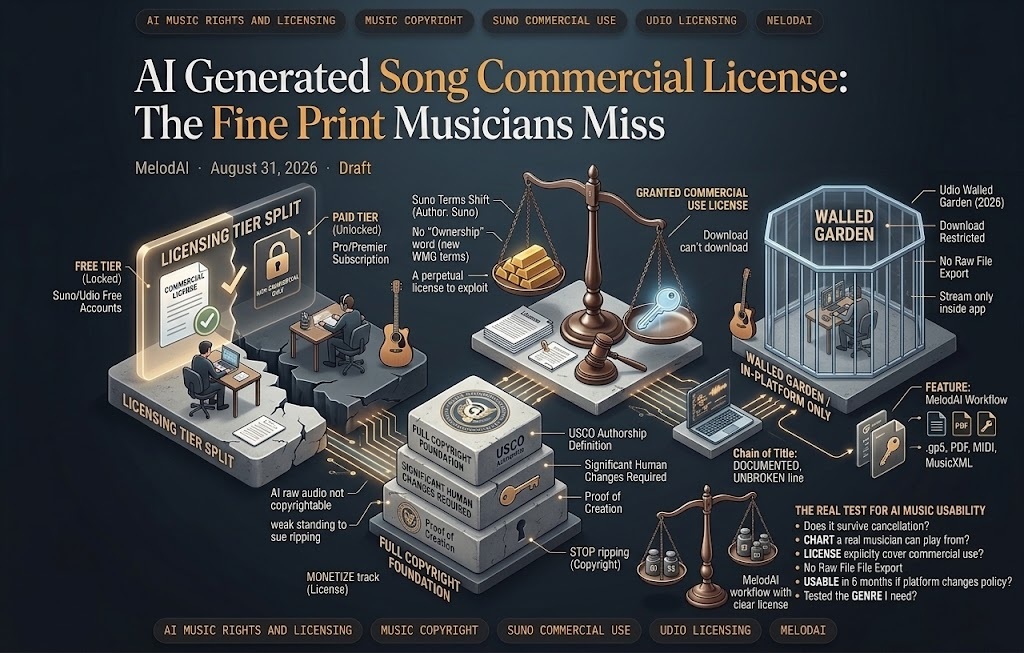
Suno's terms used to be blunt about this. As of November 2025, the site read plainly that paid subscribers own their outputs. That language didn't survive the year. <cite index="4-13,4-14">Under the new WMG-influenced terms, Suno has removed the word ownership for users, with Suno technically remaining the author of the audio while the user is granted a perpetual license to exploit it commercially.</cite> That's a meaningful shift — a license to use something is not the same as owning it.
The industry press covered the change in real time. <cite index="2-11,2-12">Suno's retooled resource now reads that users may be granted commercial use rights, which allow them to reproduce the songs to sell or distribute, but that even with granted commercial rights, users generally are not considered the owner of the songs.</cite> If you built a release plan around the word 'ownership,' that plan needs revisiting.
Misconception #1: Every Tier Gets Commercial Rights
This one's the most common and the easiest to fact-check. <cite index="3-1,3-2,3-3">Music created on the free tier is limited to non-commercial use — you cannot distribute it, monetize it, or use it in commercial projects, and Suno retains ownership of music created on free accounts.</cite> Udio runs the same split. <cite index="6-5">Both platforms follow the same basic model: free plans are non-commercial, paid plans grant commercial rights.</cite> Upgrading later doesn't retroactively fix anything, either — <cite index="3-22,3-23">retroactive rights are not guaranteed, and if you created a song on the free tier and later subscribe to Pro, you do not automatically receive commercial rights to that song.</cite>
Misconception #2: A Commercial License Equals Copyright Protection
This is the one that actually matters if someone rips off your track. A license from a platform governs what you're allowed to do with the output — it says nothing about whether the U.S. Copyright Office will register it. <cite index="4-15,4-16">The Copyright Office generally does not recognize AI-generated audio as copyrightable, meaning you can monetize a track but you cannot copyright it in its raw form.</cite> That has real teeth: <cite index="4-17">if someone re-uploads your AI-generated hit, your legal standing to sue is weak unless you've made significant human changes to the output, like re-recording vocals or adding live instruments.</cite> A commercial license lets you sell the track. It doesn't let you stop someone else from selling it too, unless you've added enough human authorship to claim copyright.
Misconception #3: The License Is Permanent Regardless of What Happens Next
Most users assume a granted commercial license is static — you get it, it stays yours, done. In practice it's tied to your subscription status at the moment of creation. <cite index="6-16">Tracks generated on a paid plan retain their commercial license even if you later cancel your subscription</cite> — but only for what you made while paying. Terms also change underneath you: <cite index="3-8,3-9,3-10,3-11">Suno's Warner deal triggers significant platform changes in 2026, including licensed models replacing current ones, with current v5.x and earlier models expected to be deprecated.</cite> If your workflow depends on a specific model or a specific set of terms, don't assume it'll look the same in six months.
Misconception #4: You Can Always Export Your Song and Use It Anywhere
This is the newest and most consequential shift. Udio changed course entirely in late 2025. <cite index="12-2,12-4">The update, finalized on October 29, 2025, affects users' ability to download their own songs, marking a reversal from prior terms that allowed downloading for personal and commercial use.</cite> The direction of travel is toward keeping you inside the platform. <cite index="7-19,7-20,7-21">Following its agreement with Universal Music Group, Udio is building toward a walled garden in 2026, where users stream and customize tracks inside the platform rather than freely exporting them elsewhere.</cite> A commercial license that only lets you use a song inside one app is a very different product than one that lets you take a file and put it wherever you want.
Every paid MelodAI plan carries the same royalty-free commercial license from the moment you generate — no free-tier trap, no retroactive gap.
Download .gp5, PDF, MIDI, and MusicXML directly. No walled garden, no in-platform-only streaming requirement.
Sell it, sync it, stream it, or build a session around the tab — the license is written to cover commercial use without asterisks.
This is exactly why chain of title matters if you're pitching a track for sync licensing or working with a music library. <cite index="5-15">A music supervisor licensing a track for a film, an ad agency clearing a jingle, or a stock-music platform onboarding a catalog all need a documented, unbroken line showing who owns what and who is allowed to license it.</cite> A murky 'granted rights, not ownership' clause doesn't give you that. Neither does a platform that won't let you download the file in the first place.
There's also a practical distribution problem stacking on top of the legal one. <cite index="6-23">Spotify removed over 75 million AI-generated tracks in 2025, and their detection systems flag unprocessed AI exports automatically.</cite> Musicians uploading raw AI output are increasingly running into moderation, not just licensing questions. If your track is going to survive contact with a streaming platform's detection systems and a label's legal team, the license needs to be clean and the file needs to be something you can actually work with — not just an MP3 you generated and hope holds up.
What a Commercial License Should Actually Guarantee
A license worth paying for should answer four questions clearly, without you needing to read a legal blog to figure it out: who can use the track commercially, whether that right survives a subscription cancellation, whether you can export the raw files, and what happens if the underlying terms change. MelodAI's paid plans are built to answer all four the same way every time — royalty-free commercial rights attached to the output, full export access, no walled-garden requirement to stream only inside the app. That's the standard the rest of this space is still negotiating around lawsuits and settlements.
| License Question | MelodAI | Suno / Udio (typical) |
|---|---|---|
| Free tier commercial use | N/A — paid plans only | ✗ Non-commercial only |
| Ownership language | Clear royalty-free commercial license | Shifted to 'granted rights,' not ownership |
| Raw file export (audio + tabs) | ✓ .gp5, PDF, MIDI, MusicXML | Increasingly restricted |
| License tied to model deprecation | ✗ Not applicable | ✓ Risk as models are phased out |
None of this means AI-generated music can't be part of a real release strategy — it clearly can, and thousands of musicians are already doing it. It means the license you're granted is the actual product you're buying, and it's worth reading past the marketing page before you build a catalog on top of it. Know what tier you're on, know whether that grant survives cancellation, and know whether you can get the files out of the platform at all.
Generate the song. Get the tab. Keep the rights.
Royalty-free commercial license on every paid plan — no walled garden, no fine print you have to decode.
Get a commercial license you can actually explain to a client
Generate a track, get the guitar, bass, piano, and drum tabs automatically, and export everything — audio and files — under one clear royalty-free commercial license.
Start creating